The content of this website is mine alone and does not necessarily reflect the views of the U.S. Government, the Peace Corps, or the Panamanian Government.

Saturday, October 29, 2016

New to Site

As I sat down to write this blog post, it was a challenge to sum up nearly six weeks living in my community, Barranquilla. As you read, you will see that brevity escaped me, but I tried to add in lots of pictures to make the read more enjoyable! My last post was a while ago; I had just been officially sworn in as a Volunteer and was preparing to move to my site. Now, I have been living in Barranquilla for about six weeks and my life is very different!

What a view!
I am living with a host family until the end of December. There is never a dull moment at the house because I am living with 16 other people. I have my host parents, a host aunt, a host grandma, and 12 host siblings ranging from age 18 to 8 days old. I spend a lot of time hanging out with my host siblings talking, playing cards, and of course being asked hundreds of questions about America and life in the US. Some of the most common questions I get are: how much everything costs (especially my plane ticket from the US to Panama), why I have hair on my arms (the Ngabe do not), how to say things in English, and what the heck those spots are on my face (my freckles). 
My host family house 

They seriously love playing cards


No really, they take pics with the cards


Everyone is genuinely curious and I've had some interesting conversations with my community. One night, we got on the topic of astronomy and I (having taken a very advanced semester of Astronomy 100 in college) felt pretty confident in answering their questions. I learned very quickly that not only was my knowledge a little spotty almost two years after taking that class, but my vocabulary to explain the basics of the solar system in Spanish was also surprisingly limited. It all worked out because we moved on to other topics ranging from food to geography to when I'm going to get married and have children. My love life is a favorite topic in my community because many people are surprised to find out that I am 22, unmarried, and have no children. Usually, by age 22 women in my site would have had a man and probably a couple children.  

One highlight early on was the morning I learned how to process cacao. My host family has a farm where they grow a ton of different things: Banana, plantain, pifa, coffee, cacao, and dashin just to name a few of the major crops. Most of the food is for my family to eat, but they do grow coffee to sell. We harvested some cacao from their farm and broke open the pods. Inside, the cacao looks a lot like an almond and is surrounded by a white fruit that you eat. Then the cacao dries out and ferments for a few days. In the morning, we roasted the cacao over our fire and then had to peel the shells off the very hot cacao pods. Then we ground up the cacao and it was ready to use. We used it to make chocolate, oatmeal, and peanut butter cookies. They were a huge hit with the whole family!!
Pifa trees


Toasting the cacao
A cacao pod
All toasted!
Everybody helping mix up the cookies


My community has two sections: Barranquilla 1 (where I live) and Barranquilla 2 (about a 40 minute walk from where I live). There is a large school near my house that goes up until 9th grade. In my first few months living in Barranquilla I have to get to know the community members, learn about my site, and do an analysis to decide what projects we will work on in my two years. I spend a typical day visiting people's houses to get to know them and explain about the Peace Corps and what I'm doing. I also attend lots of community meetings about everything from the water system to school activities.


I was able to visit my water source, a stream about 30 minutes from my community, and check out the water system. I definitely learned a lot about some of the issues we have with the system just from checking out the water source (and still have a lot to figure out).

Some community members after working hard to
 clean up the water source

I have been able to visit a few other Volunteers in their sites already. My closest neighbor is just a one hour walk from my site, so we see each other often. I even went to visit her for her birthday last week! I also attended another neighbor's school anniversary activity. It was a lot of fun to check out a bigger and more developed community.

The celebration was Hawaiian themed 
Bonus: I learned how to make balloon animals
for the kids


One day was particularly eventful. I happened to be visiting a neighboring Volunteer and when I returned home, the house was very quiet; it was much quieter than usual. I put my stuff down and was playing with my youngest host siblings (ages 1 and 1.5), when I heard crying. Crying is a very frequent event at my house and all over my community, so I didn't pay very much attention to it. Then I realized that I was looking at the usual criers of my house and both were silent. It dawned on my that my host mom must have had her baby while I was gone! My host mom was very pregnant when I got to Barranquilla, but when I asked when she was due, the response was very typical: "soon." Times, dates, and locations are details that usually get a vague answer something like, "soon" or "over there." So, I was never quite sure when this new baby was going to be born. It turns out that October 20th suited the baby just fine. My new baby host sister was just a few hours old when I met her and she is adorable (of course, I am totally biased). She doesn't have a name yet, but as the family discussed potential options, I suggested a nice middle name might be Emily. We'll see if they go for it or not! Needless to say, it's been a crazy week with a brand new baby in the house; she brings our total count up to 17 people in the house.

My youngest host sister the day she was born
I am now gearing up for a visit from one of my Peace Corps program managers to see how I'm doing and to observe one of my community meetings. I am primarily working on parts of my community analysis, continuing to get to know the community, and attending meetings. At the end of December, I will be moving into my own house!! This is really exciting because, although I love my host family, I will be able to cook for myself. Right now, I eat with my host family, so my diet largely consists of rice and buchu (a small, green banana that is boiled). My family, and many others in the community, cook on a fugón, or an open fire. I certainly have not mastered the art of cooking over the open flame, but those cookies we made turned out great despite the lack of temperature control. 

I have really enjoyed my first weeks in Barranquilla, and despite the many challenges, am excited to keep working with some very amazing, dedicated people!! Comment with any questions you have and I'll do my best to keep updating the blog as often as possible.

And now enjoy several pictures of my host siblings and neighbors:      

With Máximo (1 yr old host brother)


Irinelda (13 yr old host sister)


Friday, September 16, 2016

It's Official!!!

Since I returned from Barranquilla and my site visit, a lot has changed! In the last few weeks, I finished PST (training), moved out of my host family in Santa Rita, and swore in as an official Peace Corps Volunteer. It's been a crazy few weeks and I'm trying to update my blog one last time before I move into my site tomorrow and have much more limited access to internet.

In the last few weeks of training, I began to learn Ngäbere, the indigenous language spoken in my site. It’s a huge challenge and I’ve forgotten how difficult it is to start learning a new language. I don’t know how to say much, but in class, I made a video introducing myself in Ngäbere. 


I am saying my name, where I’m from, who I’m working with, what I’ll be doing, and that I am excited to be in Barranquilla. I am also wearing a Nakwa (pronounced Nag-wah), the traditional dress of the Ngäbe people. The dresses are typically worn by women and decorated by “dientes,” which are the colorful stripes and designs embroidered on the dress. Many women in Barranquilla wear the nakwa, so hopefully I can acquire a few of my own!


I also wanted to give my host family in Santa Rita a gift, but it was hard to come up with something that would work for my host parents and both host sisters. I decided to make dinner with another VOLUNTEER because our host families are related. After much debate and a thorough cost-benefit analysis, we decided to make tacos. It sounded really simple, but just finding all the ingredients proved difficult. We spent over an hour in the grocery store calculating what .78 kilograms meant in pounds, how many Panamanians that would serve, and searching for crunchy taco shells. Overall, the dinner was a huge success and we did not burn down the house or give anyone food poisoning. It was quite a feast and we had so much leftover, that we fed a bunch of volunteers too!      


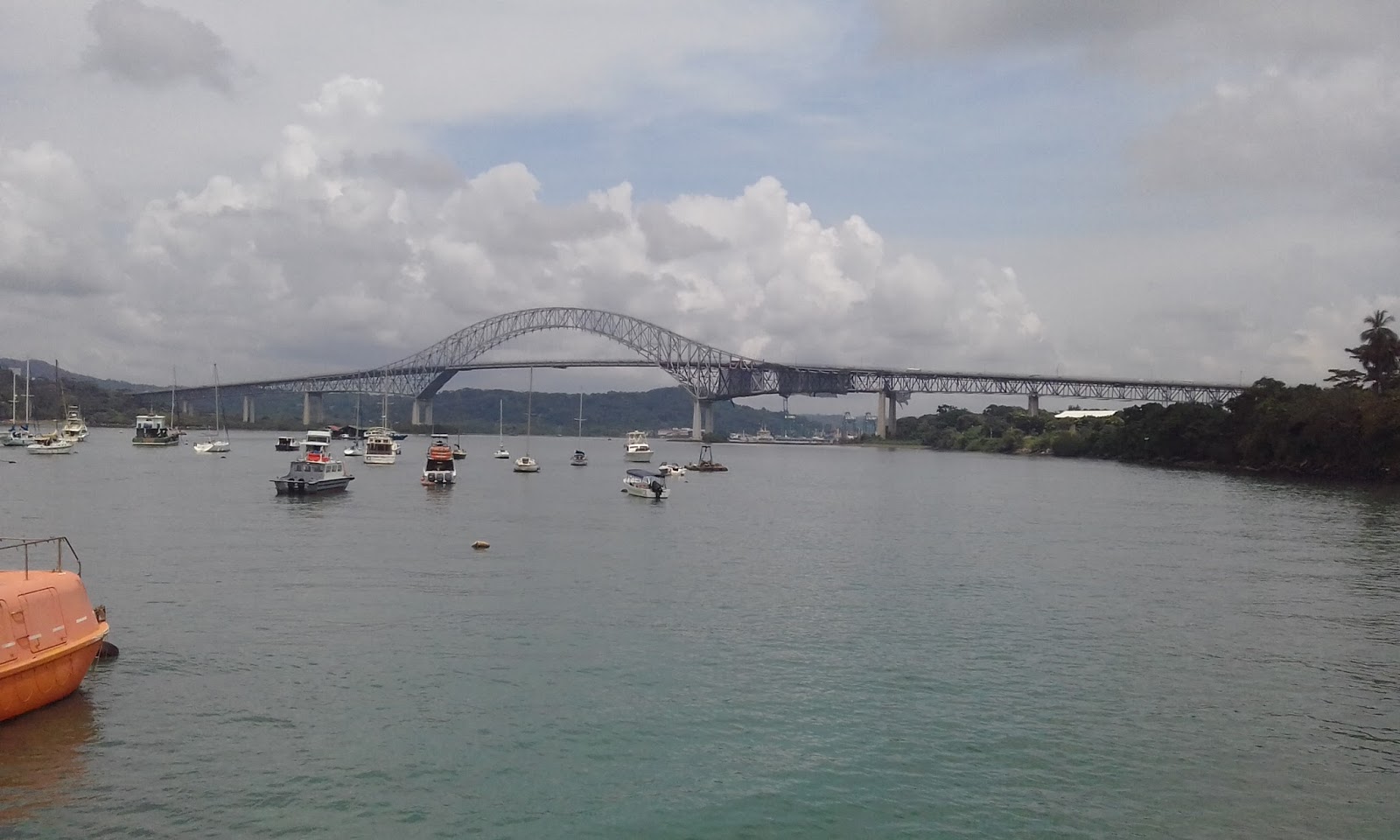
During my last weekend in Santa Rita, I took a trip to an island with a few other volunteers. We went to Isla Taboga, which is a small island about a 30 minute boat ride from Panama City. There were same awesome views of the city from the boat. It was a perfect day to hang out on the beach and escape Santa Rita for a while.

The Bridge of the Americas
Panama City in the distance 

My host sister and host cousin


To finish off our time in Santa Rita, the volunteers worked with our language teachers to plan a "despedida" or sendoff/goodbye party with our host families. It was the perfect way to thank them for all the hard work they put in over the last 11 weeks. We had a ton of food, games for the kids, and several performances. The volunteers translated a song into Spanish and sang it for the families and my Ngäbere class presented a traditional dance called the "baile de las mariposas" (dance of the butterflies). It was a lot of fun!!
Piñata scrums are culturally universal


On Monday morning, at 4am, I gathered up all of my stuff and headed out of my host family. The volunteers spent two days in Panama City staying near the Peace Corps Office for the final training sessions.   

They are heavier than they look...
Heading to Swear-In

Wednesday was a much awaited day: I finally upgraded from a trainee and swore in as a Volunteer. It was a very cool ceremony that took place in the center of Casco Viejo (the old part of town, and the best in my opinion). We had leaders from the agriculture and health ministries, as well as the US Ambassador to Panama and the Peace Corps Panama Country Director present. Our entire training staff was also there!! All 45 members of G79 swore in and officially became Peace Corps Volunteers.  

G79 after Swear-In


WASH G79


After swear in, we had two free days to celebrate and enjoy each other's company before we all head our separate ways. We spent some time in Panama City and also went to the beach for a night. It was a lot of fun and a perfect chance to celebrate together!

Fountain in Panama City


During our last day at the beach, we gave each other paper plate awards. It was really adorable! I was voted "best site nickname." My Ngäbe name is Buchi, which means little guava and is what all the people in my site call me.

My paper plate award!
PST has been quite the crazy, busy, informative experience! Tomorrow, I'll be arriving in my site and starting my work as a Volunteer. During my first three months, I will not be leaving my site often so that I will be able to focus on integrating and doing a community analysis. After the first three months (around the end of December), I will move into my own house and no longer live with a host family. I will also be able to start working on projects and have a few more training events. I can't wait to get started on this journey and get back to Barranquilla!

PS: I will be using WhatsApp almost exclusively to communicate. Download it and I (or my parents :) can get you my Panamanian number!

Monday, September 5, 2016

¡Barranquilla!


A couple weeks ago, I found out where my site will be for the next two years! The previous 5 weeks of training all led up to this point. I will be living and working in a community called Barranquilla for the next two years. It is in Ñökribo, which means the part of the Comarca Ngäbe Bugle that is in Bocas del Toro Province. It is a community of about 60 houses and 500 people and is three hours away from the closest large city. Just a few days after getting my site announcement, I spent a week visiting Barranquilla.

On an early Monday morning at the Peace Corps Office, I met my community guide and host dad, Victorino. Each trainee had a guide come to Panama City to pick them up and take us back to our sites. After a long day of icebreakers and sessions, the group going to Bocas headed for our sites. To get to Barranquilla, I take an 8-hour bus from Panama City to David. We got there at 3:30am and luckily spent a few hours sleeping before continuing the journey. Then I take a smaller bus for two hours and finally a chiva (local transport) for an hour to my site.

Me with my guide and host dad

Once I arrived in site, I met the rest of my host family. I will be the 12th person living in the house! It took me nearly all week to work out everyone’s names and ages, but I finally did it! I live with my host parents, my host mom’s sister, a host grandma, and 7 kids ages 1 to 13. The entire family was really nice and welcoming. I didn’t have a very busy agenda for the week, so I spent a lot of time getting to know my host family. My host siblings learn English in school, so at night we did language lessons; I taught them English and they taught me Ngäbere. Ngäbere is the local indigenous language that is spoken throughout much of the Comarca and in Barranquilla. A lot of community members, especially the older ones, really enjoyed yelling Ngäbere at me, and then laughing at my clueless stares.


I was able to introduce myself to all of the teachers and every class at the school! One of the teachers even took me to the river one afternoon and we walked up the entire river. A highlight of the week was my “naming baptism.” Typically, volunteers in indigenous sites receive Ngobe names from their communities that they use during service. We had a town meeting where I introduced myself and explained a little bit about Peace Corps and my role as a Volunteer. Then, the community discussed what to name me and a few minutes later I had a Ngobe name: Buchi Yokibo! Buchi in Ngäbere literally means small guava and Yokibo is named after a nearby river.

One of my host sisters
Barranquilla is surrounded by mountains and the views are just amazing! I am really lucky because there are not too many bugs (like mosquitos) in my site and I have not yet seen any scorpions or snakes. It was a great week to spend in site and start getting to know the community and my host family!


Once I was back in my training community near Panama City, we started another week of training. This week has been great because I started Ngäbere classes. I get a few classes to start learning the basics of the language and then will have follow-up classes after I go to my site. It’s very challenging to learn as much of a new language as possible in just 5 classes, but it will be very helpful once I’m in site. Training is quickly coming to an end; on September 14th I will swear in as a Volunteer and then head back to Barranquilla for good. During the first 3 months in site, I will live with my host family and focus on analyzing the community. After 3 months, I will move into my own house and begin working on projects with the community. I can’t believe how quickly training has gone and am excited to get back to Barranquilla!